
SEO vs GEO vs AEO: What's the Difference?
Discover the differences between SEO, GEO and AEO, how they work together and where your business should focus its search marketing efforts.

For many years, Google has been the default starting point for people looking for products, services and businesses. However, an increasing number of people are also turning to AI platforms such as ChatGPT to help them make purchasing decisions, compare service providers and find recommendations.
Rather than searching Google for a handful of keywords, potential customers might ask ChatGPT a much more specific question, such as:
Can you recommend an experienced independent SEO consultant in Norfolk who specialises in technical SEO and website migrations?
For businesses, this presents another opportunity to be discovered by potential customers. But how do you increase the likelihood of your business being recommended by ChatGPT?
The answer involves a combination of established SEO principles, generative engine optimisation (GEO), entity SEO and building a credible online reputation.
ChatGPT can draw upon information learned during model training and, when using web search, retrieve information from publicly accessible online sources.
These sources may include:
Your company website.
Industry publications.
Business directories.
Independent review websites.
Professional associations.
News articles and interviews.
Third-party websites that mention your business.
The information available to ChatGPT depends on the capabilities being used, the user's question and the sources available at the time.
There is no single ranking system that businesses can optimise for in the same way they might approach traditional organic search rankings.
Instead, the objective is to make your business easier to discover, understand and accurately represent.
This forms an important part of Generative Engine Optimisation (GEO). If you're unfamiliar with the terminology, my guide to the differences between SEO, GEO and AEO explains how these disciplines work together.
Before attempting to improve your AI search visibility, it's important to understand what you're actually trying to achieve.
Type of visibility | Description |
|---|---|
Brand mention | Your business is named within an AI-generated response. |
Recommendation | Your business is suggested as a suitable provider based on the user's requirements. |
Citation | Your website or another source is referenced to support information within the response. |
Referral visit | A user clicks a link within the response and visits your website. |
These are not necessarily the same thing.
Your business could be recommended by ChatGPT without a direct link to your website. Equally, one of your articles could be cited as an information source without your business being recommended as a service provider.
Understanding these differences is essential when evaluating the effectiveness of your AI SEO strategy.
Technical accessibility is one of the first areas I would investigate when assessing a company's AI search visibility.
If important content cannot be accessed by relevant search crawlers, opportunities for that content to be retrieved and referenced may be limited.
Your technical SEO checks should include:
Ensuring important pages return a successful HTTP status code.
Identifying unintended crawler restrictions in your robots.txt file.
Checking for incorrect noindex directives.
Maintaining a logical website structure.
Providing clear internal links to important content.
Ensuring essential information is accessible without unnecessary JavaScript dependencies.
Maintaining an accurate XML sitemap.
OpenAI uses different crawler and user-agent identities for different purposes.
Crawler | Purpose |
|---|---|
OAI-SearchBot | Discovers content for OpenAI's search experiences. |
GPTBot | Crawls content that may be used to improve and train AI models. |
ChatGPT-User | May access websites in response to user-initiated actions. |
Importantly, allowing access for search discovery and allowing content to be used for model training are separate decisions.
Website owners should review OpenAI's crawler documentation and determine which access policies are appropriate for their business.
Allowing crawler access does not guarantee that your business will be recommended, but removing unintended accessibility barriers is a sensible starting point.
One of the most important aspects of AI search optimisation is helping search engines and large language models understand exactly who you are.
This is where entity SEO comes into play.
An entity is a distinct, identifiable concept, such as a person, business, organisation, product or location.
Your website and wider digital presence should clearly communicate:
Your business name.
What your business does.
Your products and services.
Your geographical location and service areas.
Your specialist areas of expertise.
The people behind the business.
Relevant qualifications and professional memberships.
Your industry experience.
This information should be accurate and consistent across your website, social media profiles, business directories and other relevant platforms.
Consider two roofing companies.
The first describes itself as a trusted roofing contractor providing high-quality services at competitive prices.
The second clearly explains that it specialises in flat roof installations, EPDM rubber roofing and commercial roof repairs across Norfolk and Suffolk.
The second business provides considerably more context about its expertise, services and geographical coverage, making it easier for potential customers and AI platforms to understand when its services are relevant.
Specificity matters. Make it clear what your business does, where it operates and who it helps.
Structured data provides machine-readable information about your website, organisation, people and services.
Depending on your business, relevant Schema.org markup might include:
Organization
LocalBusiness
Person
Service
Product
Article
BreadcrumbList
For example, Organisation structured data can describe your company name, website, logo, contact information and associated social profiles.
Person structured data can provide additional information about article authors, their professional experience and their relationship with your business.
However, structured data should not be treated as a shortcut to AI visibility.
There is no special schema markup that guarantees your business will be recommended by ChatGPT. Its purpose is to describe genuine information and relationships more explicitly.
Publishing a handful of generic blog posts is unlikely to establish your business as an authority within its industry.
Instead, develop comprehensive, interconnected content that addresses the questions, problems and decisions your potential customers encounter.
For example, a business specialising in website migrations might publish content covering:
How to plan an SEO migration.
How to preserve organic traffic during a website redesign.
Common website migration mistakes.
How to implement and test redirects.
What to do if traffic drops following a migration.
How to monitor SEO performance after launch.
Each article addresses a distinct customer need while contributing to a broader body of expertise.
This approach, often referred to as building a topical cluster, can help both users and search systems discover relationships between relevant topics and commercial services.
The objective is not to publish as much content as possible. It is to become a genuinely useful resource within your area of expertise.
One of the challenges businesses face is differentiating themselves from the growing amount of generic AI-generated content published online.
Creating content that offers something genuinely useful or original is increasingly important.
Consider incorporating:
First-hand professional experience.
Original research and industry data.
Client case studies.
Practical examples.
Screenshots and demonstrations.
Industry-specific recommendations.
Expert commentary.
Lessons learned from previous projects.
For example, rather than simply publishing an article explaining what a technical SEO audit is, an experienced consultant could demonstrate how they identified and resolved an indexing issue on a real website.
This provides information that goes beyond generic definitions and demonstrates practical expertise.
You can read more about demonstrating expertise and trust in my guide to E-E-A-T and SEO.
Your website is only one source of information about your business.
If other credible organisations independently reference your company, this provides additional information about your reputation, expertise and activities.
Relevant opportunities might include:
Industry publications and trade magazines.
Professional body membership listings.
Specialist industry directories.
Interviews and podcast appearances.
Conference and event participation.
Industry awards.
Research collaborations.
Customer reviews.
Expert contributions to relevant articles.
Traditional backlinks remain important, but an independent brand mention can also provide useful context about your business, even when it is not accompanied by a link.
I explore this further in my article Brand Is the New Backlink: The Future of SEO in the AI Era.
Focus on earning recognition from sources that are genuinely relevant to your industry rather than accumulating large numbers of low-quality directory listings.
When potential customers ask ChatGPT to recommend businesses, they may include requirements relating to reputation, experience and reliability.
For example:
Can you recommend a reputable wedding photographer in Norfolk with excellent customer reviews and experience photographing outdoor weddings?
A business with clearly documented experience, genuine customer reviews and relevant examples of its work provides more publicly accessible evidence relating to those requirements.
Depending on your industry, concentrate on:
Maintaining an accurate Google Business Profile.
Encouraging genuine customer reviews.
Responding professionally to customer feedback.
Publishing detailed case studies.
Maintaining relevant professional accreditations.
Keeping third-party business profiles up to date.
These activities are valuable regardless of whether customers discover your business through Google, ChatGPT or another platform.
Traditional keyword research remains valuable, but conversational search allows potential customers to express more detailed requirements.
Compare the following examples:
Traditional search query | Conversational AI prompt |
|---|---|
SEO consultant Norfolk | Can you recommend an independent SEO consultant in Norfolk who works with small businesses? |
Golf holidays Spain | Where should a group of eight golfers stay near Málaga if they want to play three different courses? |
Roofing contractors Norfolk | Can you recommend a roofing company in Norfolk that specialises in EPDM flat roof replacements? |
Wedding photographer Norfolk | Can you recommend a photographer in Norfolk who specialises in natural, documentary-style wedding photography? |
These prompts contain considerably more information about the customer's requirements.
Review your website and ask whether it clearly communicates the information needed to address these more specific needs.
Your service pages should explain not only what you offer, but also:
Who your services are intended for.
Which problems you solve.
Your specialist capabilities.
Where you operate.
Your approach and methodology.
What differentiates your business.
Evidence of relevant experience.
This benefits potential customers visiting your website while also providing clearer context for search systems.
A useful starting point for an AI visibility audit is to ask ChatGPT questions about your business and industry.
Start with branded prompts:
What does [business name] do?
Where is [business name] based?
What services does [business name] offer?
What is [business name] known for?
Then move on to non-branded prompts that reflect how potential customers might discover you:
Can you recommend businesses that specialise in [service]?
Who provides [service] in [location]?
Which companies have experience solving [specific problem]?
Can you recommend a reputable provider of [service]?
Look for the following:
Is your business mentioned?
Is the information accurate?
Are your specialist services correctly identified?
Which competitors are recommended?
Which websites are referenced as sources?
Be aware that responses may vary between sessions, models and locations. A single response should not be treated as a definitive measure of your visibility.
Repeating a consistent set of prompts over time can provide a more useful indication of changes.
One of the biggest mistakes businesses can make when measuring AI search performance is focusing exclusively on referral traffic.
Consider a potential customer who asks ChatGPT to recommend an SEO consultant. They may discover a business within the response and then:
Search for the company name on Google.
Read customer reviews.
Visit the company's website.
Submit an enquiry.
In this scenario, Google Analytics may attribute the visit to organic search rather than ChatGPT.
This is why I believe AI search visibility should be assessed alongside broader search and business performance metrics.
My approach focuses on three areas: Visibility, Engagement and Conversions (VEC).
Area | What to monitor |
|---|---|
Visibility | AI mentions, recommendations, citations, competitor appearances and organic search impressions. |
Engagement | Referral traffic, branded searches, engaged sessions and website interactions. |
Conversions | Enquiries, sales, telephone calls and other valuable business actions. |
While an increase in branded searches may be consistent with greater AI discovery, it does not prove that ChatGPT was responsible. Combining multiple data sources provides a more balanced view of performance.
Use this checklist to assess whether your business has established the foundations for greater AI search visibility.
Important website content is accessible to relevant search crawlers.
Your business name, services and location are clearly communicated.
Your brand information is consistent across online platforms.
Relevant structured data has been implemented.
Your website demonstrates genuine industry expertise.
You publish helpful content around your specialist topics.
Your business earns credible third-party mentions.
You maintain genuine customer reviews and case studies.
You monitor AI-generated responses for brand accuracy.
You track AI visibility alongside traditional SEO and business outcomes.
Getting your business recommended by ChatGPT is not about finding a hidden optimisation trick or implementing a handful of technical changes.
It is about building a business that is discoverable, recognisable, credible and relevant to the needs of potential customers.
Many of the activities that support AI search visibility are also fundamental to a successful traditional SEO strategy. Strong technical foundations, authoritative content, entity clarity and a credible online reputation all have an important role to play.
My recommendation is to treat generative engine optimisation as an extension of your existing SEO strategy, not as a replacement for it.
If you would like help assessing and improving how your business appears across ChatGPT, Google AI Overviews, Gemini and other AI-powered search experiences, explore my AI SEO and GEO services.
There is no general-purpose business submission process that guarantees inclusion in ChatGPT recommendations. Businesses can improve their discoverability by maintaining accessible content, consistent brand information and a credible online presence.
ChatGPT does not provide fixed rankings comparable to traditional Google search results. Recommendations can vary according to the prompt, available sources, model and user context.
ChatGPT may retrieve information from publicly accessible review websites and other third-party sources when using web search. However, businesses should not assume that any particular review platform is always consulted.
Structured data provides machine-readable information about your business, services and relationships. It is a useful part of an SEO strategy, but there is no guarantee that implementing it will result in ChatGPT recommendations.
There is no fixed timeframe. Improvements depend on your existing online presence, website accessibility, industry competition, content quality and the availability of reliable information about your business.
No. ChatGPT independently generates responses based on the user's requirements and available information. SEO and GEO can improve the foundations for discoverability but cannot guarantee recommendations.
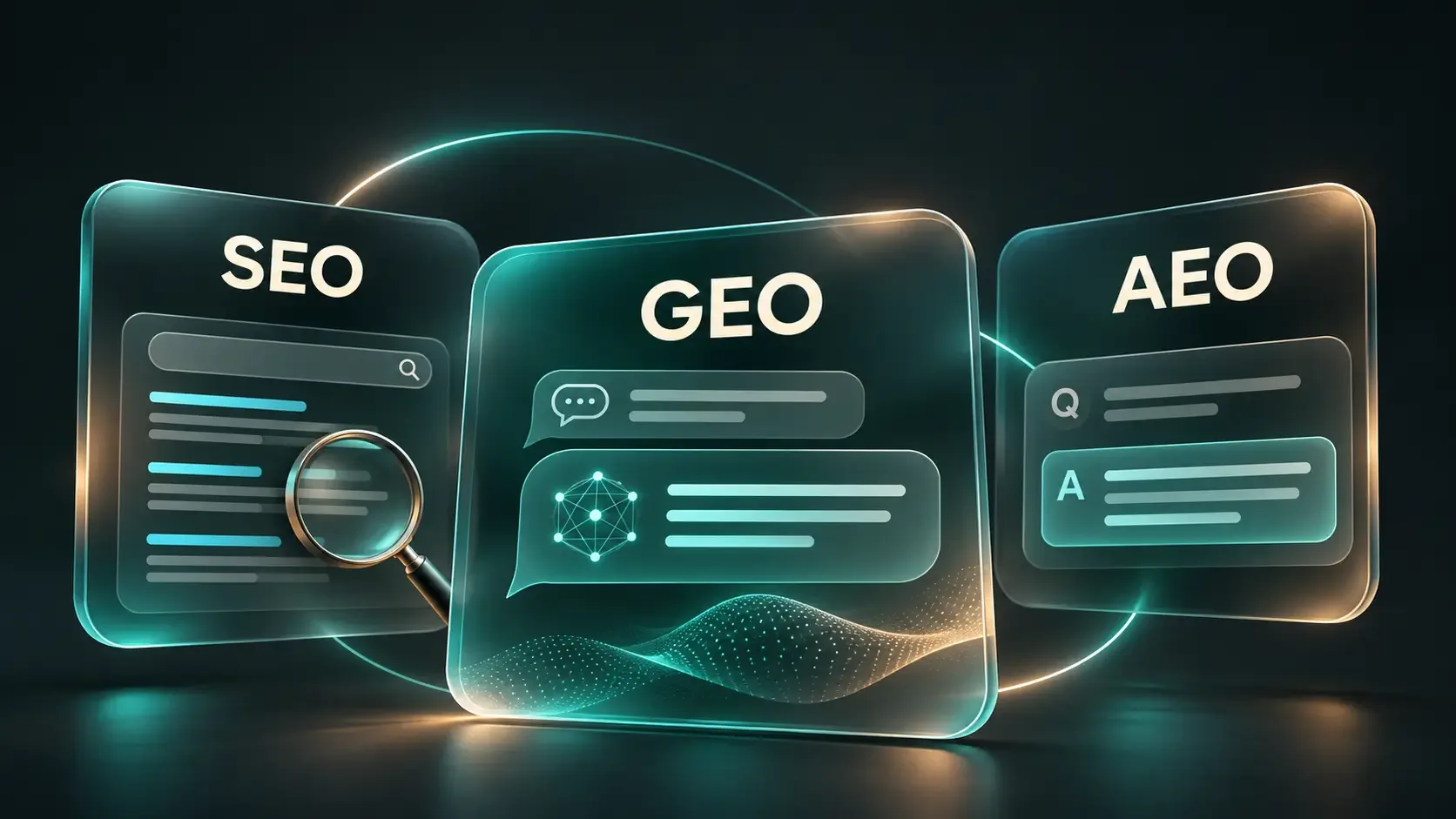
Discover the differences between SEO, GEO and AEO, how they work together and where your business should focus its search marketing efforts.
Search itself is not being reinvented overnight. Search results are. That is the clearest message from DataForSEO's Search Insider: 2026 Edition.
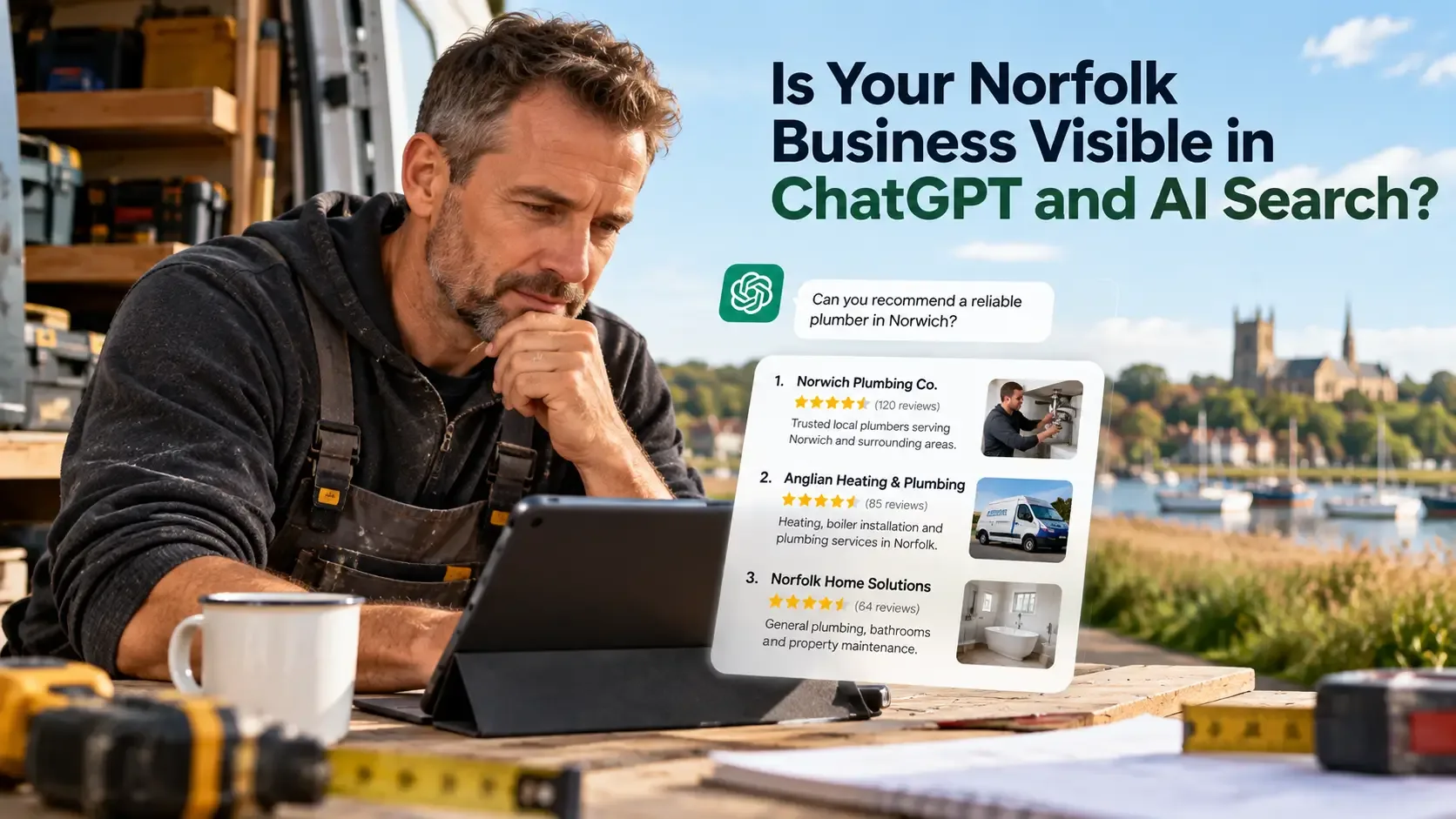
The way people find businesses online is changing.For years, Google has been the starting point for customers searching…